
About the Heritage Centre
The Sault Ste Marie Métis Heritage Centre, located on John Street, exists to preserve the history and culture of the local Métis community, and to educate future generations and the general public on the subject. It is the first of its kind in Ontario. The Heritage Centre consists of three buildings: the Museum, the Community Hall, and an office building.
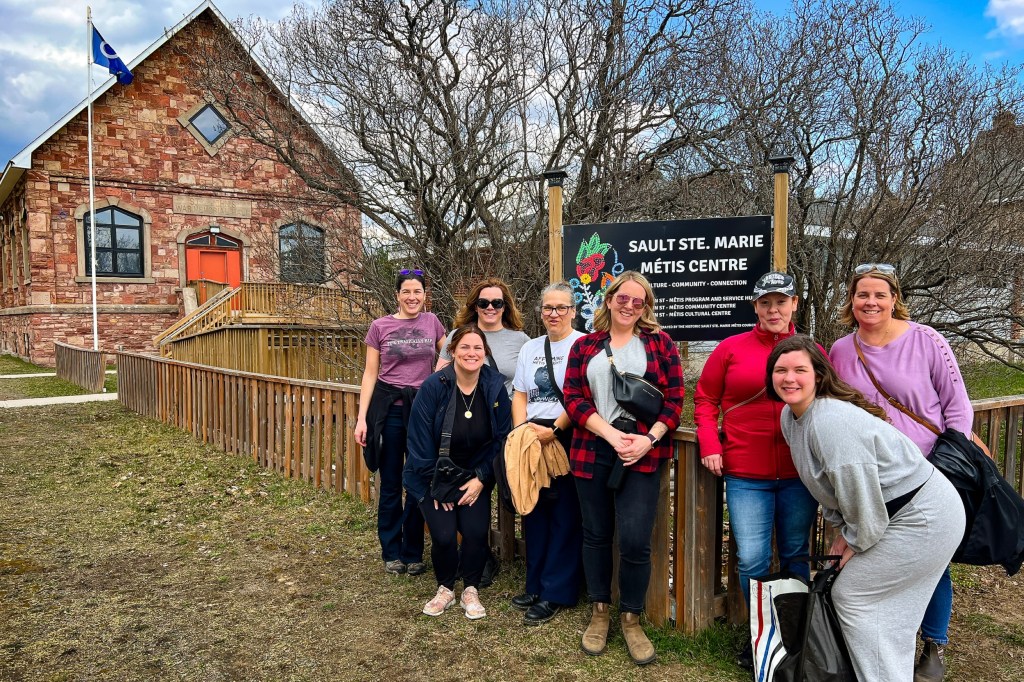
The Museum is located in a renovated church that was previously known as St. John’s the Evangelist Anglican Church. It has a main exhibit hall, a small programming space, and a gift shop.
The Community Hall is located in the old Memorial Hall. It features a large room with plenty of space for events and meetings, and a commercial kitchen for community use.
The office building is not open to the public, and was previously known as the rectory or house where the minister lived. It is currently rented as offices to the Métis Nation of Ontario.
The project for the Heritage Centre began in 2017 with the closure of the Anglican Church, who transferred ownership of the site to the SSM Métis Council. The project experienced various planning and funding setbacks over the course of 7 years. The Heritage Centre held its grand opening on October 19th, 2024. It opened its doors to public visitors on August 13th, 2025.
The Heritage Centre is operated by the Historic Sault Ste. Marie Métis Council and is supported by the Métis Nation of Ontario and Heritage Canada.
About the Community
The Métis are a distinct Indigenous people with our own history and culture. Born of the fur trade, the Métis are the descendants of the children born to European traders and First Nations women. As these mixed-ancestry children grew up, intermarried, and had their own children, a new people—the Métis—emerged.
In the late 1790s and early 1800s in the Upper Great Lakes and across West Central North America, Métis communities emerged and coalesced, transitioning from mixed ancestry individuals, to a people with a culture, worldview, traditions and political identity.
Several historic Métis communities emerged in what is now Ontario, and the community at Sault Ste. Marie became the best known. The Historic Sault Ste. Marie Métis Community established its settlement on the north shore of the St. Mary’s River. They built their homes on long, narrow “river-lots” and lived their way of life based around fishing, hunting, maple sugar making and fur trading. They lived lives of a unique spirituality, a distinctive Métis blend of Anishinaabe traditions and folk Catholicism. They danced to the rhythm of the fiddle on Saturdays and were protective of their place in the world, refusing to give up their unique identity and be represented by their First Nations relatives.
In the 1990s and early 2000s the Sault Ste. Marie Métis Community rallied behind two men from our community, father and son Steve and Roddy Powley, in their 10-year battle in the courts, which led to the first ever Canadian Constitutional recognition of a rights-bearing Métis community. The Sault Ste. Marie Métis Heritage Centre exists to preserve this 200 plus year long legacy and ensure the survival of our culture and history.
About the Buildings
The Sault Ste. Marie Métis Heritage Centre resides in the buildings that previously made up St. John’s the Evangelists Anglican Church. Prior to the Anglican Church being built, the site’s recorded history begins in the days of the fur trade. A trading post, known as Fort Creek, was established nearby at the mouth of the creek (now called, Fort Creek) by the Northwest Trading Company that was later taken under the ownership of the Hudson’s Bay Company. Behind the Fort and a short distance up the creek, a plot of land was designated as a graveyard or cemetery “for company employees”.
The land designated as a cemetery is the land upon which the Métis Heritage Centre now sits. It is well documented that, as those who lived here year-round were predominantly part of the Métis community, the graveyard itself was predominately comprised of Métis burials.
In the early to mid 1800s, the Hudson’s Bay Company began winding down its presence in Sault Ste. Marie, and the cemetery expanded to be used for the whole town until 1865, when a new town cemetery was opened elsewhere. As it was no longer needed for burials, the land was allowed to return to bush and the graves were forgotten about, at least by members of the primarily European-descended communities.
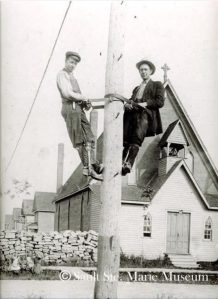
The cemetery remained largely unknown to the public, until excavation for the Memorial Hall’s basement uncovered a number of graves, which were moved to the town cemetery. Some burials remain on-site to this day; however, the deceased were placed in shallow graves and any remains have long since decomposed. There are no surviving grave markers, as they would have originally been made of wood, and also decomposed over the decades.
Out of respect for the history of this being a predominantly Métis cemetery, the Anglican Church transferred ownership of the land to the Sault Ste Marie Historic Métis Council when St. John’s closed in 2017.
The Museum is housed in the church building itself. It was built in 1901, alongside the rectory to house the minister and his family. Originally it was called St. John’s Chapel of Ease, as it was meant to be convenient for new workers and their families inhabiting the Steelton area who could not always walk into Sault Ste. Marie during bad weather. The stained-glass window that still exists to this day was gifted to the church in 1905. The first services were conducted by Albert Lancefield, who left in 1902. The final service was held on August 28th, 2016.
The Memorial Hall, which is now the Community Hall, was built in 1919 to remember veterans of the First World War. On December 8th, 1921, two bronze tablets listing the men who served were unveiled, and those tablets remain in the hall to this day.
 Métis Heritage Centre